


Sodium Hypochlorite (Bleach): Why It Is Excluded Under the No Nines™ Standard™

Bleach works. There is no question about that.
Sodium hypochlorite has been used for decades as a disinfectant, sanitizer, and bleaching/whitening agent, because it is inexpensive, readily available and capable of destroying a broad range of microorganisms.
The No Nines™ Standard™ asks a different question:
When formulating products intended for routine use around people, skin, pets and the home, is this chemistry necessary when highly effective alternatives with very different exposure profiles are available?
For sodium hypochlorite bleach, our answer is no.
Conventional bleach combines high alkalinity and relatively high chlorine concentration with documented eye, skin and respiratory hazards, significant chemical incompatibilities, and the potential to release dangerous, toxic gases when mixed with other common household chemicals. ¹⁻⁵
And there is another important distinction: sodium hypochlorite bleach is not the same thing as a properly formulated hypochlorous acid solution.
Sodium hypochlorite and hypochlorous acid are related—but they are not equivalent
When chlorine exists in water, two of its principal free-chlorine species are hypochlorous acid (HOCl) and the hypochlorite ion (OCl⁻):
HOCl ⇌ H⁺ + OCl⁻
The proportion of each is controlled primarily by pH. At lower, mildly acidic to near-neutral pH, substantially more of the available chlorine exists as HOCl. As pH rises, the equilibrium shifts toward OCl⁻. Conventional sodium hypochlorite bleach is deliberately maintained at a high alkaline pH for stability, so the hypochlorite ion predominates. ¹˒²
That difference matters enormously to antimicrobial performance.
HOCl can be dramatically more bactericidal than OCl⁻
Classic disinfection studies reviewed by the National Research Council found hypochlorous acid to be approximately 70–80 times as bactericidal as the hypochlorite ion under controlled experimental conditions. ¹
Other controlled research has estimated approximately a 50-fold difference under particular test conditions, reinforcing the same principle: chlorine concentration alone does not determine antimicrobial activity. The chemical form of that chlorine matters.¹
HOCl is electrically neutral and can interact with microbial cell structures more efficiently than negatively charged OCl⁻. Its antimicrobial action includes oxidation of proteins, enzymes, membrane components and other essential cellular targets.²
Why that matters for concentration
This is why comparing a bottle of HOCl with a bottle of bleach simply by looking at “ppm chlorine” can be misleading.
A solution dominated by the more microbicidal HOCl species can achieve substantial antimicrobial activity while containing far less available chlorine than a high-pH sodium hypochlorite solution.
In a peer-reviewed study published in the Journal of Bioscience and Bioengineering, researchers compared slightly acidic electrolyzed water at 23 mg/L (ppm) available chlorine with sodium hypochlorite at approximately 120 mg/L. The HOCl-rich solution reduced E. coli, Staphylococcus aureus, and Salmonella by approximately 4.8–5.2 log in 60 seconds. Despite containing more than five times less available chlorine, its bactericidal performance was not significantly different from the sodium hypochlorite solution.³
A separate study comparing 20 ppm slightly acidic electrolyzed water with 120 ppm sodium hypochlorite on fresh-cut cucumbers found the lower-chlorine HOCl-dominant treatment produced equivalent or greater microbial reductions under the tested conditions. ⁴
These studies should not be interpreted as a universal 70–80-to-1 concentration conversion, but they are illustrative. Microbial efficacy always depends on the organism, formulation, pH, contact time, temperature, organic load and application.
But they demonstrate the practical importance of the chemistry:
HOCl does not need to be present at bleach-like concentrations to deliver powerful antimicrobial activity.
That is one of the reasons properly formulated HOCl chemistry can have a very different exposure profile from conventional sodium hypochlorite bleach.
The exposure profile of conventional bleach
The clinical toxicology of sodium hypochlorite is well documented.
Exposure can affect the eyes, skin, gastrointestinal tract and respiratory system, with severity dependent on concentration, dose, exposure route and duration. Concentrated solutions can produce significant chemical injury.⁵
The clinical toxicology literature describes ocular irritation and injury, skin irritation and chemical burns, gastrointestinal injury following significant ingestion, and respiratory effects following inhalation of chlorine-containing vapors or gases generated during misuse.⁵
This is an important distinction from saying simply that “all chlorine is toxic.” It is not.
Dose, pH, chemical species, formulation and route of exposure determine risk.
That same principle is why the safety profile of a dilute, pH-controlled HOCl solution should not be inferred from the hazard profile of concentrated alkaline sodium hypochlorite bleach.
Bleach and respiratory exposure
Cleaning products are a recognized source of occupational respiratory exposure.
Medical reviews and occupational-health literature have associated cleaning and disinfecting work with asthma and asthma-like symptoms, including exposure to chlorine-based cleaning products. ⁶˒⁷ The effects can involve irritation rather than classical allergic sensitization; high-level irritant exposure can produce reactive airway dysfunction and asthma-like symptoms even without an allergic mechanism. Therefore, bleach can be described primarily as a respiratory irritant and potential trigger of irritant-induced airway disease⁶˒⁷
Symptoms associated with significant chlorine or cleaning-chemical exposure can include cough, throat irritation, wheezing, chest tightness, shortness of breath, eye irritation and headache.⁶⁻⁸
Bleach + acid: chlorine gas
One of the most serious risks associated with sodium hypochlorite is chemical incompatibility.
Bleach should never be combined with acidic cleaners.
Lowering the pH of a sodium hypochlorite solution shifts chlorine chemistry and can release molecular chlorine gas (Cl₂). Acute chlorine exposure can injure the eyes and respiratory tract and can produce cough, bronchospasm, shortness of breath, pulmonary inflammation and, at sufficiently high exposure, serious lung injury. ⁸˒⁹
A published case series of patients exposed after hypochlorite disinfectants were mixed with acidic household cleaners documented hypoxemia, inflammatory lung changes and, in one patient, respiratory failure. ⁸
The danger is not theoretical.
In 2019, a manager at a Buffalo Wild Wings restaurant in Burlington, Massachusetts, died after a sodium-hypochlorite cleaner containing approximately 8–10% NaOCl came into contact with a strongly acidic cleaning product. The reaction generated toxic fumes; 13 other people sought hospital treatment.¹⁰
Bleach + ammonia: chloramine gases
Bleach should also never be mixed with ammonia-containing products.
Hypochlorous species react with ammonia to form chloramines. At elevated airborne concentrations, chloramine gases can produce rapid irritation of the eyes, nose and respiratory tract.
A clinical review of 216 household chlorine/chloramine exposures documented the real-world consequences of these accidental mixtures. ¹¹ More recent poison-center research has likewise documented cough, nasal irritation and ocular irritation following chloramine exposure from mixing household cleaners.
Again, the concern is not that sodium hypochlorite spontaneously produces dangerous gas during every normal use. The concern is that its chemistry creates serious incompatibilities with chemicals (particularly those used in other cleaning products) commonly found in the same household.
Bleach and organic matter
Sodium hypochlorite is a powerful oxidant. When bleach encounters organic material, it does not simply perform its intended cleaning function and disappear.
Hypochlorite and related reactive chlorine species can react with organic compounds present in soils, body fluids, food residue, surfactants, fragrances and indoor surfaces.
Environmental chemistry research has demonstrated formation of halogenated volatile organic compounds during use of some chlorine-bleach-containing household products. Compounds measured in experimental studies have included chloroform and other chlorinated VOCs.¹²˒¹³
The amount produced depends heavily on formulation, concentration, organic material, ventilation and use conditions. The research does not mean that ordinary bleach use automatically creates hazardous exposure levels.
It does demonstrate, however, that the environmental fate of bleach is more chemically complex than the simple statement that it “turns into salt and water.”
Poison exposures and cleaning products
Cleaning products also account for a substantial number of accidental exposures.
A long-term U.S. emergency-department analysis found household cleaning products responsible for significant numbers of injuries, particularly among young children.¹⁴
During the increased use of cleaners and disinfectants in early 2020, U.S. poison centers recorded a substantial increase in cleaner-related exposures, with bleach accounting for 62.1% of the increase in cleaner exposures compared with the prior year.¹⁵
More recent National Poison Data System reporting continues to place household cleaning substances among the major substance categories involved in poison-center exposures.¹⁶
Bleach is a major contributor to household cleaning-product exposures reported to U.S. poison centers.
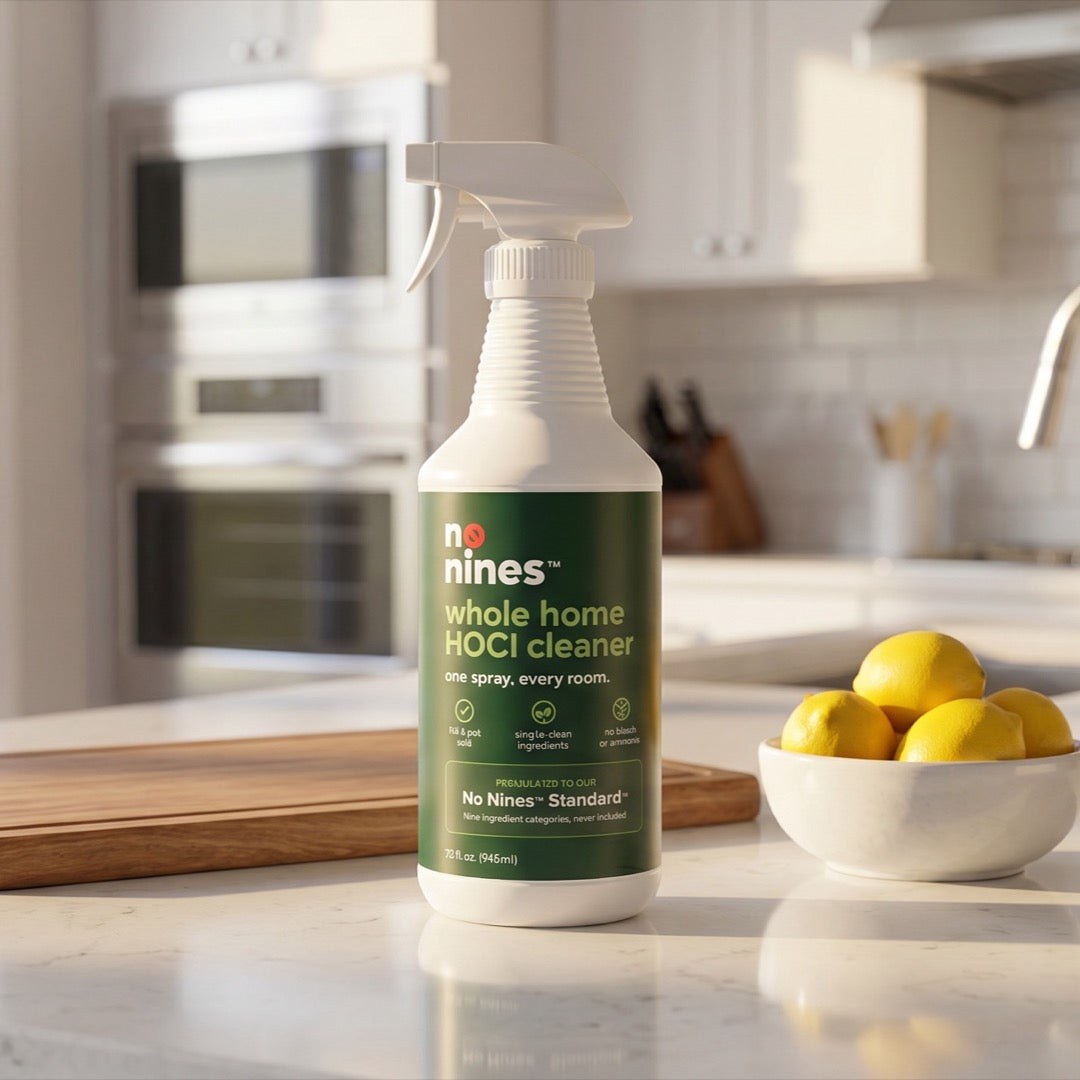
Why No Nines excludes bleach—but formulates with HOCl
At first glance, excluding sodium hypochlorite while using hypochlorous acid can sound contradictory.
Chemically, it is not.
The No Nines™ Standard™ distinguishes between a high-pH sodium hypochlorite bleach formulation dominated by OCl⁻ and a dilute, carefully pH-controlled formulation designed so that hypochlorous acid is the predominant active chlorine species.
The distinction involves:
chemical species + pH + concentration + intended use + exposure profile.
HOCl's substantially greater bactericidal activity relative to OCl⁻ means that effective HOCl formulations can operate at far lower available-chlorine concentrations than conventional alkaline bleach formulations in appropriate applications.¹⁻⁴
That difference is supported not only by theoretical chemistry, but also by experimental microbiology showing equivalent antimicrobial performance from HOCl-dominant solutions containing a fraction of the available chlorine used in sodium hypochlorite comparator solutions.³˒⁴
No Nines does not exclude bleach because bleach “doesn't work.” Bleach works.
We exclude sodium hypochlorite because its concentration, alkalinity, corrosive exposure profile, respiratory concerns, chemical incompatibilities and reactive chemistry are not consistent with the formulation choices we want to make for everyday No Nines products.
No Nines™ Standard™
Effective chemistry doesn't require unnecessary exposure.
Our ingredient decisions consider not only whether an ingredient can perform a function, but also how much is required, how people are exposed to it, what happens when it is misused, and whether a different chemistry can accomplish the intended purpose with a more favorable exposure profile.
Published Sources & Further Reading
- National Research Council (US), Safe Drinking Water Committee. Drinking Water and Health, Volume 2: The Disinfection of Drinking Water. Washington, DC: National Academies Press; 1980. Reviews controlled studies reporting hypochlorous acid approximately 70–80 times as bactericidal as hypochlorite ion under specified conditions.
- Fukuzaki S. Mechanisms of actions of sodium hypochlorite in cleaning and disinfection processes. Biocontrol Science. 2006;11(4):147–157. doi:10.4265/bio.11.147.
- Issa-Zacharia A, Kamitani Y, Tiisekwa A, Morita K, Iwasaki K. In vitro inactivation of Escherichia coli, Staphylococcus aureus and Salmonella spp. using slightly acidic electrolyzed water. Journal of Bioscience and Bioengineering. 2010;110(3):308–313. doi:10.1016/j.jbiosc.2010.03.012.
- Liu Z, Dong Y, Jiang W. Decontamination efficiency of slightly acidic electrolyzed water on fresh-cut cucumbers. International Journal of Food Engineering. 2011;7(5). doi:10.2202/1556-3758.2233.
- Slaughter RJ, Watts M, Vale JA, Grieve JR, Schep LJ. The clinical toxicology of sodium hypochlorite. Clinical Toxicology. 2019;57(5):303–311. doi:10.1080/15563650.2018.1543889.
- Quirce S, Barranco P. Cleaning agents and asthma. Journal of Investigational Allergology and Clinical Immunology. 2010;20(7):542–550.
- Siracusa A, De Blay F, Folletti I, et al. Asthma and exposure to cleaning products: a European Academy of Allergy and Clinical Immunology task force consensus statement. Allergy. 2013;68:1532–1545. doi:10.1111/all.12279.
- Lin GD, Wu JY, Peng XB, et al. Chlorine poisoning caused by improper mixing of household disinfectants during the COVID-19 pandemic: case series. World Journal of Clinical Cases. 2022;10(25):8872–8879. doi:10.12998/wjcc.v10.i25.8872.
- Huynh Tuong A, Despréaux T, Loeb T, Salomon J, Mégarbane B, Descatha A. Emergency management of chlorine gas exposure—a systematic review. Clinical Toxicology. 2019;57(2):77–98. doi:10.1080/15563650.2018.1519193.
- Boerner LK. Accidental mix of bleach and acid kills Buffalo Wild Wings employee. Chemical & Engineering News. 2019;97(45). American Chemical Society.
- Mrvos R, Dean BS, Krenzelok EP. Home exposures to chlorine/chloramine gas: review of 216 cases. Southern Medical Journal. 1993;86:654–657.
- Odabasi M. Halogenated volatile organic compounds from the use of chlorine-bleach-containing household products. Environmental Science & Technology. 2008;42(5):1445–1451. doi:10.1021/es702355u.
- Odabasi M, Elbir T, Dumanoglu Y, Sofuoglu SC. Halogenated volatile organic compounds in chlorine-bleach-containing household products and implications for their use. Atmospheric Environment. 2014;92:376–383. doi:10.1016/j.atmosenv.2014.04.049.
- McKenzie LB, Ahir N, Stolz U, Nelson NG. Household cleaning product-related injuries treated in U.S. emergency departments in 1990–2006. Pediatrics. 2010;126:509–516. doi:10.1542/peds.2009-3392.
- Chang A, Schnall AH, Law R, et al. Cleaning and disinfectant chemical exposures and temporal associations with COVID-19—National Poison Data System, United States, January 1–March 31, 2020. Morbidity and Mortality Weekly Report. 2020;69:496–498. doi:10.15585/mmwr.mm6916e1.
- Beuhler MC, Feldman R, Gummin DD, et al. 2024 Annual Report of the National Poison Data System from America's Poison Centers: 42nd Annual Report. Clinical Toxicology. 2025;63(12):1029–1280. doi:10.1080/15563650.2025.2571299.