


Quaternary Ammonium Compounds (Quats): Why No Nines™ Leaves Them Out

Quaternary ammonium compounds—usually called quats or QACs—are a large family of chemicals widely used in disinfectants, sanitizers, preservatives, surfactants and other household, institutional and personal-care products.
They work. That isn't the question.
For No Nines™, the question is whether this chemistry is necessary in products intended for repeated use in homes and around people and animals when another chemistry can accomplish the intended purpose with a more favorable exposure profile.
The research gives us several reasons to choose differently.
Occupational respiratory exposure
QAC-containing disinfectants have been associated with occupational asthma, including cases confirmed through controlled inhalation challenge testing.⁴˒⁵
Skin exposure
Common QACs are established skin irritants, and members of the class have been associated with irritant and allergic contact dermatitis.⁸˒⁹
Reproductive and developmental research
Experimental findings have raised sufficient concern for researchers to identify QACs as an emerging area of reproductive and developmental toxicology.¹⁰
Measurable human exposure
QACs have been detected in human blood and human breast milk.¹¹˒¹²
Surface residues
QACs can remain after a treated surface appears dry. Recent residential research identified ingestion of surface residues as an important exposure route for several QACs.¹⁵˒¹⁷
Pet exposure and toxicity
QAC exposure has been documented in dogs and cats, and fatal poisoning following accidental QAC disinfectant exposure has been documented in dogs.¹³˒¹⁴
Environmental exposure
QACs enter wastewater systems, can partition into sludge, sediments and soils, and certain QACs are toxic to susceptible aquatic organisms.¹˒¹⁶˒¹⁷
Antimicrobial resistance
Bacteria can develop mechanisms of QAC tolerance and resistance. The potential relationship between extensive antimicrobial use and antibiotic resistance remains an active area of research.¹˒¹⁸
A very large chemical family
Quats are not one ingredient. They include hundreds of individual chemicals and mixtures—with approximately 800 QACs reported in Canadian commerce alone—and toxicological information is not equally complete for every member of the family.¹
No single study is the basis for the No Nines™ decision.
It is the overall exposure profile—repeated contact, surface residues, occupational respiratory effects, measurable human and animal exposure, environmental considerations and areas of emerging toxicological concern—that informs our formulation standard.
Read the research
The sections below explain these concerns and the published research behind them.
Quats are a chemical family—not a single ingredient
A quat contains a permanently positively charged nitrogen atom surrounded by four chemical groups. Changing those groups creates different QACs with different antimicrobial activity, environmental behavior and toxicity.
Common examples include:
- Benzalkonium chloride, also called BAC or BAK
- Alkyl dimethyl benzyl ammonium chloride, or ADBAC
- Didecyldimethylammonium chloride, or DDAC
- Dioctyldimethylammonium chloride
- Octyl decyl dimethyl ammonium chloride
- Cetrimonium chloride
- Cetrimonium bromide
- Cetylpyridinium chloride
- Benzethonium chloride
- Alkyltrimethylammonium compounds
- Dialkyldimethylammonium compounds
The terminology can make quat exposure surprisingly difficult for consumers to recognize. Even benzalkonium chloride may describe mixtures containing different alkyl-chain lengths rather than one uniform molecule.¹
The U.S. Environmental Protection Agency historically grouped quaternary ammonium pesticide active ingredients into four structural clusters for purposes of data development and regulatory assessment.²
The broader QAC family, however, contains hundreds of individual chemicals and mixtures with differences in chemical structure, use, exposure and toxicological data.¹
A major 2023 scientific review reported information on approximately 800 QACs used in Canadian commerce alone.¹
Why are quats used?
Certain QACs disrupt microbial cell membranes and proteins, making them useful antimicrobial agents.
For that reason, they are common active ingredients in EPA-registered antimicrobial pesticide products, including many surface disinfectants and sanitizers.¹˒³
Their use increased substantially during the COVID-19 pandemic. A 2023 scientific review reported that QACs were active ingredients in approximately half of the products then listed by EPA for use against SARS-CoV-2.¹
But antimicrobial effectiveness does not make a chemical biologically inert to everything else it contacts.
The same chemical properties that make certain QACs effective antimicrobial agents are also relevant to their interactions with human cells, animals, microorganisms and aquatic organisms.
Occupational asthma and respiratory exposure
Respiratory effects are among the most established occupational concerns involving disinfectant quats.
Cases of occupational asthma caused by QAC-containing disinfectants have been documented and confirmed through controlled bronchial challenge testing.⁴˒⁵
A multicenter study identified 22 workers with occupational asthma confirmed by positive specific inhalation challenge tests in which a QAC was identified as the causative agent. Most worked in healthcare-related occupations.⁵
A separate study involving 543 healthcare workers examined occupational exposure to cleaning and disinfecting agents. Of the participants, 335 were exposed to QACs. The researchers reported associations between workplace exposure patterns and physician-diagnosed asthma and work-related nasal symptoms.⁶
Earlier clinical reports also documented nurses who developed asthma associated with benzalkonium-chloride-containing disinfectants, with reactions reproduced during controlled exposure testing.⁴
Not every epidemiological study has produced identical findings. In a large U.S. nurses' study, several disinfectant exposures were associated with poor asthma control, while estimated QAC exposure itself was not independently associated with poor asthma control in that particular analysis.⁷
Taken together, the occupational literature identifies QAC-containing disinfectants as an important class to consider when evaluating work-related respiratory exposure.
Skin irritation and contact dermatitis
QACs can also affect skin.
Benzalkonium chloride is a well-established skin irritant, and dermatology literature has identified multiple QACs associated with irritant or allergic contact dermatitis, including benzalkonium chloride, DDAC, cetrimonium compounds, benzethonium chloride and cetylpyridinium chloride.⁸
Reported reactions can include:
- redness
- burning
- itching
- swelling
- dermatitis
- blistering or vesicular reactions
- more severe skin injury following significant exposures
The potential for irritation and allergic sensitization is not identical for every QAC. Benzalkonium chloride, for example, is recognized primarily as a strong irritant, while true allergic reactions occur less commonly.⁸˒⁹
Repeated occupational exposure is particularly relevant because some workers may handle QAC-containing disinfectants many times during a workday.
Protective-equipment requirements depend on the particular chemical, concentration and finished formulation. Product labels and Safety Data Sheets may require gloves, eye protection or other precautions for certain QAC-containing products.
Reproductive and developmental effects
Reproduction and development have become important areas of QAC research.
A 2024 review published in Biology of Reproduction examined experimental and human evidence concerning reproductive and developmental effects associated with QAC exposure. The authors described QACs as emerging reproductive and developmental toxicants and identified substantial remaining research needs.¹⁰
Experimental research reviewed in that paper raises questions involving:
- fertility and reproductive function
- developmental effects
- endocrine-related pathways
- mitochondrial function
- lipid and cholesterol metabolism
Human evidence remains much more limited than the experimental literature, particularly for the chronic, comparatively low-level exposures that may occur through routine consumer use.¹⁰
This is an evolving field of research, but one relevant to evaluating a chemical class used repeatedly in homes, workplaces and personal-care environments.
Quats have been measured in human blood
Human exposure is measurable.
In a 2021 biomonitoring study, researchers measured QAC concentrations in blood samples from 43 people.
QACs were detected in 80% of the study participants.¹¹
Higher measured blood QAC concentrations were statistically associated with changes in inflammatory markers, mitochondrial function and cholesterol-homeostasis measurements.¹¹
The study demonstrated that exposure to these compounds can extend beyond the surface or product in which they were originally used.
QACs have been detected in human breast milk
In 2022, researchers reported the first measurement of QACs in human breast milk.¹²
Researchers tested for 18 QACs and detected 13 different compounds, with seven detected in more than half of the samples.¹²
The findings demonstrate another pathway by which QAC exposure can extend beyond the product or surface on which these chemicals were originally used.
Pets can be exposed—and severe poisoning has occurred
Pets are particularly relevant to household disinfectant exposure because dogs and cats walk on floors, lie on treated surfaces and may subsequently lick their paws or coats.
A 2024 study examining 27 QACs documented exposure in pet dogs and cats. QACs were measured in fecal samples, while metabolites of benzalkonium compounds were detected in urine.¹³
Accidental higher-level exposure can be much more serious.
A 2023 veterinary case report documented two dogs accidentally exposed to quaternary ammonium disinfectants in kennel environments.¹⁴
Both dogs developed severe injuries involving the gastrointestinal tract, lungs and skin. Both were ultimately euthanized because of the severity of their illness and lack of response to treatment.¹⁴
The veterinary authors specifically warned clinicians about the potential for severe and fatal outcomes following QAC disinfectant exposure.¹⁴
Quats can remain after the surface looks dry
Many disinfectant QACs have very low vapor pressure.¹⁷
When a QAC-containing liquid is applied to a surface, the water or other carrier may evaporate, but the QAC itself does not necessarily evaporate with it.
The active ingredient can remain behind as a surface residue.
That residual behavior can be intentional in some antimicrobial applications. From an exposure perspective, however, it also means that chemical contact may continue after a surface appears dry.
QACs have been measured in indoor environmental samples including:
- household dust
- hand wipes
- indoor air
- silicone passive samplers
- urine.¹⁵
A 2026 Environmental Science & Technology study collected paired indoor dust, air, hand-wipe, silicone-wristband and urine samples from 109 adults living in urban homes. Researchers detected 23 QACs across the indoor environmental samples and identified ingestion of surface residues as an important exposure route for several benzalkonium compounds.¹⁵
This exposure pathway is particularly relevant when considering frequently touched surfaces and environments involving children or animals.
Environmental effects do not necessarily stop at the drain
After use, QACs from cleaning and disinfecting products can enter wastewater systems.
Because many QACs are positively charged, they can bind strongly to organic matter, wastewater solids, sediments and soil.¹˒¹⁶˒¹⁷
QACs have been documented in environmental media including:
- wastewater
- wastewater-treatment sludge
- sediments
- surface waters
- indoor dust
- soils receiving biosolids.¹˒¹⁶
Environmental research has demonstrated toxicity of certain QACs to susceptible aquatic organisms, including algae and aquatic invertebrates.¹˒¹⁶˒¹⁷
Wastewater treatment can remove substantial amounts of commonly used disinfectant QACs through biodegradation and sorption to solids.¹⁷
But removal from the water column is not the same thing as disappearance. QAC residues may instead become associated with wastewater biosolids, sediments or soils.¹⁶˒¹⁷
Environmental behavior therefore includes both degradation and redistribution into other environmental compartments.
Antimicrobial resistance is another area of research
Researchers have also studied what repeated antimicrobial QAC exposure may do to microorganisms.
Bacteria can develop reduced susceptibility to QACs through mechanisms including:
- changes in cell-envelope structure
- alterations in cell membranes
- efflux pumps
- biofilm formation
- QAC degradation mechanisms.¹⁸
Laboratory studies have demonstrated QAC tolerance and resistance, and genes associated with QAC tolerance can occur alongside genes involved in antibiotic resistance.¹˒¹⁸
These findings have raised concern that widespread antimicrobial use may create selection pressures that favor organisms with reduced susceptibility to disinfectants and, in some cases, antibiotic-resistance traits.¹˒¹⁸
For No Nines™, this is another reason to consider the broader consequences of routine antimicrobial chemistry beyond immediate surface disinfection.
Hundreds of related chemicals create another challenge
The QAC issue is not simply about benzalkonium chloride or DDAC.
It is the scale and diversity of the chemical family.
Quaternary ammonium compounds include hundreds of individual chemicals and mixtures, with information reported on approximately 800 QACs in Canadian commerce alone.¹
Differences in:
- alkyl-chain length
- molecular structure
- concentration
- formulation
- product use
- route of exposure
can affect antimicrobial activity, absorption, environmental fate and toxicity.
Yet toxicological information is not equally complete for every QAC.
The 2023 multidisciplinary review of the chemical class identified major data gaps in information concerning uses, production volumes, exposure and toxicity for many QACs.¹
That distinction matters when evaluating an entire chemical family rather than one well-studied ingredient.
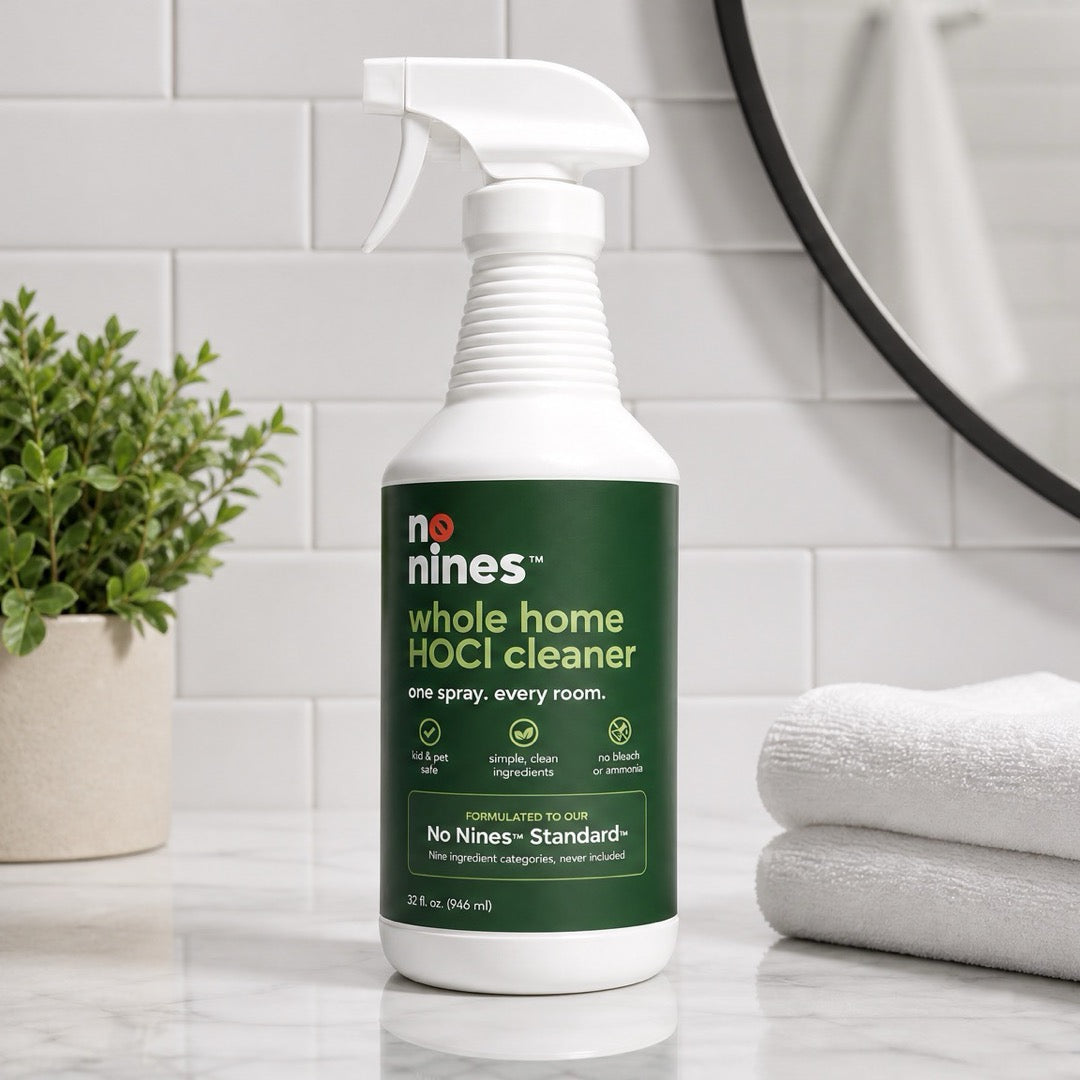
No Nines™ Standard™
Effective chemistry doesn't require unnecessary exposure.
Our ingredient decisions consider not only whether an ingredient can perform a function, but also how much is required, how people are exposed to it, what happens when it is misused, and whether a different chemistry can accomplish the intended purpose with a more favorable exposure profile.
Published Sources & Further Reading
1. Arnold WA, Blum A, Branyan J, et al. Quaternary Ammonium Compounds: A Chemical Class of Emerging Concern. Environmental Science & Technology. 2023;57(20):7645–7665. doi:10.1021/acs.est.2c08244. PMID: 37157132. PMCID: PMC10210541.
2. U.S. Environmental Protection Agency. Reregistration Eligibility Decision for Alkyl Dimethyl Benzyl Ammonium Chloride (ADBAC). U.S. EPA. Describes EPA's historical four-cluster approach for quaternary ammonium pesticide active ingredients.
3. Center for Food Security and Public Health, Iowa State University. Cleaning and Disinfection Guidelines. Quaternary ammonium compounds and antimicrobial pesticide use.
4. Purohit A, Kopferschmitt-Kubler MC, Moreau C, et al. Quaternary ammonium compounds and occupational asthma. International Archives of Occupational and Environmental Health. 2000;73(6):423–427. PMID: 11007347.
5. Migueres N, Debaille C, Walusiak-Skorupa J, et al. Occupational Asthma Caused by Quaternary Ammonium Compounds: A Multicenter Cohort Study. Journal of Allergy and Clinical Immunology: In Practice. 2021;9(9):3387–3395. doi:10.1016/j.jaip.2021.04.041. PMID: 33940212.
6. Gonzalez M, Jégu J, Kopferschmitt MC, et al. Asthma among workers in healthcare settings: role of disinfection with quaternary ammonium compounds. Clinical & Experimental Allergy. 2014;44(3):393–406. doi:10.1111/cea.12215. PMID: 24128009.
7. Dumas O, Wiley AS, Quinot C, et al. Occupational exposure to disinfectants and asthma control in U.S. nurses. European Respiratory Journal. 2017;50(4):1700237. PMID: 28982772.
8. Okeke CAV, Khanna R, Ehrlich A. Quaternary Ammonium Compounds and Contact Dermatitis: A Review and Considerations During the COVID-19 Pandemic. Clinical, Cosmetic and Investigational Dermatology. 2023;16:1721–1728. PMID: 37409071. PMCID: PMC10319159.
9. Basketter DA, Marriott M, Gilmour NJ, White IR. Strong irritants masquerading as skin allergens: the case of benzalkonium chloride. Contact Dermatitis. 2004;50(4):213–217. doi:10.1111/j.0105-1873.2004.00331.x.
10. Bobic L, Harbolic A, Warner GR. Reproductive & developmental toxicity of quaternary ammonium compounds. Biology of Reproduction. 2024;111(4):742–756. doi:10.1093/biolre/ioae107. PMID: 38959857. PMCID: PMC11473915.
11. Hrubec TC, Seguin RP, Xu L, Cortopassi GA, Datta S, Hanlon AL, Lozano AJ, McDonald VA, Healy CA, Anderson TC, Musse NA, Williams RT. Altered toxicological endpoints in humans from common quaternary ammonium compound disinfectant exposure. Toxicology Reports. 2021;8:646–656. Published online March 9, 2021. doi:10.1016/j.toxrep.2021.03.006. PMID: 33868951. PMCID: PMC8041661.
12. Zheng G, Schreder E, Sathyanarayana S, Salamova A. The first detection of quaternary ammonium compounds in breast milk: Implications for early-life exposure. Journal of Exposure Science & Environmental Epidemiology. 2022;32(5):682–688. doi:10.1038/s41370-022-00439-4. PMID: 35437305. PMCID: PMC9015285.
13. Li Z-M, Lee C, Kannan K. An exposure assessment of 27 quaternary ammonium compounds in pet dogs and cats from New York State, USA. Environment International. 2024;184:108446. PMID: 38252984.
14. Wipond M, Prittie J, Mastrocco A, Donovan TA. Fatal exposure to quaternary ammonium disinfectant in 2 dogs. Journal of Veterinary Emergency and Critical Care. 2023;33(3):380–387. doi:10.1111/vec.13299. PMID: 37102439.
15. Hu M, Li L, Zhang X, et al. Ingestion of Surface Residues Dominates Quaternary Ammonium Compounds (QACs) Exposure in Chinese Urban Homes: Evidence from Silicone Wristband Passive Sampling and Urinary Biomonitoring. Environmental Science & Technology. 2026;60(5):3947–3960. Published online January 28, 2026. doi:10.1021/acs.est.5c16557. PMID: 41601271. PMCID: PMC12895516.
16. Zhang C, Cui F, Zeng GM, et al. Quaternary ammonium compounds of emerging concern: Classification, occurrence, fate, toxicity and antimicrobial resistance. Journal of Hazardous Materials. 2023;445:130393.
17. DeLeo PC, Huynh C, Pattanayek M, Schmid KC, Pechacek N. Assessment of ecological hazards and environmental fate of disinfectant quaternary ammonium compounds. Ecotoxicology and Environmental Safety. 2020;206:111116. doi:10.1016/j.ecoenv.2020.111116. PMID: 32890921. PMCID: PMC7467655.
18. Boyce JM. Quaternary ammonium disinfectants and antiseptics: tolerance, resistance and potential impact on antibiotic resistance. Antimicrobial Resistance & Infection Control. 2023;12(1):32. doi:10.1186/s13756-023-01241-z. PMID: 37055844. PMCID: PMC10099023.