


Synthetic Fragrance / Parfum: Why No Nines™ Leaves It Out of Every Product

No Nines™ leaves synthetic fragrance and parfum out of every product we formulate — household cleaners, surface and odor-control products, cosmetics, skin care, personal care, baby products, and pet products.
We don't add fragrance to household cleaners to mask a strong cleaner smell.
We don't add it to odor-control products simply to replace one odor with another.
We don't add it to cosmetics or skin-care products to create a scent experience.
We don't add it to personal-care or baby products to make them smell “fresh.”
And we don't add it to pet products where fragrance may remain on fur, skin, bedding, and in the shared environment.
Why?
Because fragrance usually contributes scent, not the core performance of the product.
And a fragrance mixture may contain dozens or hundreds of individual materials while appearing on an ingredient label as a single word: fragrance or parfum.¹ ²
Some fragrance materials are established contact allergens.³ ⁴
Some become stronger sensitizers after oxidation.⁵
Generic fragrance labeling may make it difficult for consumers to determine which solvents, carriers, fixatives, or other fragrance components are present.¹ ⁶
Certain synthetic fragrance chemicals have demonstrated endocrine activity in experimental systems.⁸ ¹⁰
Some synthetic musk compounds have been detected in human biological samples, demonstrating that exposure can extend beyond the surface of a product or the skin.⁹
And fragrance can act as a respiratory or sensory trigger in susceptible individuals.¹¹ ¹²
For No Nines™, that leads to a very simple formulation question:
If the product works without synthetic fragrance, why add the additional exposure?
We don't.
Every product.
Every category.
No synthetic fragrance.
No parfum.
No unnecessary exposure.
One word on a label can represent a complex chemical mixture
Fragrance. Perfume. Parfum.
On an ingredient label, each can look like a single ingredient.
It isn't.
A commercial fragrance is typically a formulated mixture of many individual chemical substances selected to create a scent, carry it, stabilize it, modify how quickly it evaporates, and help it remain on skin, fabric, hair, fur, or other surfaces.
Published fragrance literature describes perfume formulations containing tens to hundreds of individual chemical materials, and complex fragrance compositions may involve several hundred substances.¹ ²
Those materials may include fragrance molecules themselves along with solvents, carriers, stabilizers, antioxidants, fixatives, and other functional components.
Yet a consumer looking at a U.S. cosmetic ingredient declaration may see only:
Fragrance
or
Parfum
The U.S. Food and Drug Administration explains that individual fragrance ingredients generally do not have to be listed separately on cosmetic labels because fragrance formulas may be treated as proprietary mixtures. Instead, the entire mixture can ordinarily be declared simply as “Fragrance.” ¹
That means the word parfum does not necessarily tell the consumer exactly which individual chemicals are present, how many are present, or the toxicological characteristics of each component.
And that is one of the central issues.
“Fragrance” is not toxicologically one ingredient.
It is a category covering potentially complex mixtures whose individual components may have very different exposure, sensitization, persistence, and biological profiles.¹ ²
Fragrance adds exposure without adding core product performance
Fragrance is generally included for one primary reason: to make a product smell a particular way.
In a household cleaner, fragrance may be used to cover the inherent smell of the cleaning chemistry or create a scent consumers associate with cleanliness.
In personal care, fragrance may be added to suggest freshness, luxury, cleanliness, or a particular sensory experience.
In a pet product, fragrance may be used to replace an undesirable odor with a more pleasant one.
Scent is not cleaning performance.
It does not measure whether soil has been removed.
It does not measure antimicrobial activity.
It does not tell us whether the source of an odor has actually been eliminated.
And it does not improve the fundamental function of a skin mist simply because the product smells pleasant.
Synthetic fragrance instead adds another chemical mixture — and another route of exposure.
Depending on the product and the ingredients involved, fragrance materials may:
- remain on skin after application;
- remain on hair or fur;
- transfer to clothing, bedding, towels, or household surfaces;
- evaporate into indoor air;
- be inhaled during spraying or use;
- contact the eyes or respiratory tract;
- undergo chemical changes after exposure to air; and
- in some cases, be absorbed into the body.⁵ ⁹ ¹¹ ¹²
For No Nines™, an ingredient that contributes primarily scent has to justify those additional exposures.
Synthetic fragrance does not.
Fragrance is an established source of skin sensitization and allergy
Fragrance allergy is not simply a dislike of strong smells.
It can represent a true immunologic response.
Allergic contact dermatitis occurs when the immune system becomes sensitized to a substance and subsequently reacts when the skin encounters it again.
Symptoms can include:
- redness;
- itching;
- burning;
- scaling;
- swelling;
- dryness;
- cracking; and
- recurrent eczema.
Fragrance materials are a recognized cause of allergic contact dermatitis.
A clinical review published in Dermatologic Clinics reported fragrance allergy prevalence of approximately 0.7%–2.6% in the general population, while approximately 5%–11% of patients undergoing diagnostic patch testing showed fragrance-related reactions.³
Once someone becomes sensitized, subsequent exposure to the relevant allergen can provoke dermatitis.
And because the word fragrance may represent numerous individual substances, a consumer who reacts to a fragranced product may not be able to determine from the ingredient declaration which specific material caused the reaction.¹ ³
Some fragrance allergens become more sensitizing after exposure to air
Fragrance chemistry can also change after a product is manufactured.
Two widely used fragrance materials — limonene and linalool — illustrate why.
Limonene contributes citrus-like odor notes.
Linalool contributes floral and lavender-like notes.
After exposure to oxygen in air, both can undergo autoxidation, producing compounds called hydroperoxides.⁵
Those oxidation products can be substantially stronger skin sensitizers than the original fragrance chemicals.
In a consecutive patch-testing study involving 821 dermatitis patients, 9.4% reacted to hydroperoxides of limonene and 11.7% reacted to hydroperoxides of linalool. Researchers characterized these oxidation products as potent sensitizers.⁵
A consumer product does not remain chemically isolated after manufacture.
A bottle is opened.
Air enters.
The product is used repeatedly.
Ingredients are exposed to oxygen, temperature variation, light, and time.
So exposure may involve not only what originally went into the bottle, but also compounds that form later during normal storage and use.
European regulators have expanded fragrance-allergen disclosure
The significance of fragrance sensitization is reflected in European cosmetic regulation.
The European Union has long required individual declaration of certain fragrance allergens above specified concentrations.
In 2023, the European Commission substantially expanded those requirements through Commission Regulation (EU) 2023/1545.⁴
The regulation followed scientific review by the European Scientific Committee on Consumer Safety and addressed 56 additional fragrance allergens that had clearly caused allergies in humans, beyond those already covered by earlier labeling requirements.⁴
The regulatory framework also recognizes fragrance substances that may become allergenic through processes such as air oxidation or biological activation.⁴
This is why treating parfum as if it were one uniform ingredient can be misleading.
A label may say parfum.
The body encounters the individual chemicals within that mixture.
What about phthalates?
Phthalates are frequently discussed in connection with fragrance.
Certain phthalates have historically been used as solvents, carriers, or fixatives in fragrance systems.
The phthalate most closely associated with cosmetic fragrance use in the United States is diethyl phthalate, or DEP.⁶
FDA explains that DEP has been used as a solvent and fixative in fragrances and cosmetic formulations.⁶
Because fragrance formulas may be declared collectively as “Fragrance,” FDA also notes that a consumer may not necessarily be able to determine from the ingredient label whether a fragrance formulation contains a phthalate.⁶
Phthalates are a chemical family rather than a single chemical, and members of that family have different biological and toxicological profiles.
The National Institute of Environmental Health Sciences identifies phthalates among chemical classes investigated for endocrine-disrupting effects and identifies cosmetics, fragrances, and other personal-care products as potential exposure sources.⁷
The larger issue for consumers is therefore one of visibility:
When a complex fragrance system is represented simply as “fragrance” or “parfum,” the label may not reveal which solvents, carriers, fixatives, or other fragrance components are present.¹ ⁶
That is another exposure No Nines™ chooses not to add.
Some synthetic fragrance chemicals demonstrate endocrine activity
The endocrine question extends beyond phthalates.
Certain synthetic fragrance chemicals — particularly some classes of synthetic musks — have been studied because of their interactions with hormone-responsive biological systems.
Synthetic musks have been widely used to create musk-like scents in perfumes, cosmetics, detergents, fabric products, and other fragranced consumer products.
In one laboratory study using human MCF-7 cells, researchers identified estrogen-responsive activity associated with several musk compounds, including musk xylene, musk ketone, a musk-xylene metabolite, and the polycyclic musk AHTN.⁸
The study established that certain fragrance chemicals can interact with estrogen-responsive biological pathways.⁸
Research in this area continues.
In 2024, research discussed by the National Institute of Environmental Health Sciences identified musk ambrette, a synthetic fragrance chemical, as capable of activating biological receptors involved in regulation of the reproductive endocrine axis in laboratory models.¹⁰
Researchers investigating environmental chemicals capable of influencing pathways involved in puberty and reproductive development identified musk ambrette as one compound of particular interest.¹⁰
For the No Nines™ Standard™, research like this is part of the ingredient decision.
If a chemical mixture is unnecessary for product performance, we see little reason to add that exposure simply to create a scent.
Some synthetic fragrance compounds have been detected in the human body
Fragrance exposure does not necessarily remain on the surface of the skin.
A scientific review of synthetic musk compounds reported their detection in human biological matrices including:
- blood;
- breast milk; and
- adipose tissue.⁹
The review identifies dermal absorption and inhalation among routes of human exposure to synthetic musk compounds.⁹
These findings demonstrate that some fragrance chemicals can move beyond the product itself and become part of measurable human exposure.
That becomes particularly relevant because fragrance exposure may come from many products throughout the day.
A fragranced lotion may be applied to the skin.
Laundry fragrance may remain on fabric worn against the body.
A fragranced cleaner may release volatile compounds into indoor air.
A shampoo or body product adds another potential exposure.
Perfume or cosmetics may add another.
An air freshener may add another.
A fragranced pet product may remain on an animal's fur, bedding, and in a shared indoor environment.
Products may come from different categories.
Exposure doesn't recognize those category lines.
That is why No Nines™ considers both the exposure and whether the ingredient is needed in the first place.
Fragrance is also an inhalation exposure
Fragrance is designed to become airborne.
If volatile fragrance molecules did not reach olfactory receptors in the nose, we would not smell them.
That means fragrance use inherently creates some degree of inhalation exposure.
The amount varies with:
- the specific fragrance chemicals;
- their volatility;
- concentration;
- whether the product is sprayed;
- room ventilation;
- duration of exposure; and
- individual susceptibility.
This becomes especially relevant in household cleaners, room products, body sprays, and pet sprays.
A controlled perfume-challenge study involving patients with asthma reported significant decreases in FEV1 following perfume exposure, with stronger responses among participants with more severe asthma.¹¹
FEV1 — forced expiratory volume in one second — is a standard clinical measurement of airflow from the lungs.
Other controlled research has also reported increased respiratory symptoms after fragrance exposure in some people with asthma.¹²
The research demonstrates that fragrance can act as a respiratory or sensory trigger in susceptible individuals.¹¹ ¹²
For No Nines™, adding perfume to a spray product simply to make it smell “clean,” “fresh,” or “pleasant” does not justify creating another breathing-zone exposure.
Scent is not cleanliness
Consumers have been taught for decades to associate scent with cleaning.
Lemon means clean.
Pine means disinfected.
Lavender means fresh.
Perfume means personal care.
But scent does not measure cleanliness.
It does not measure antimicrobial performance.
It does not tell us whether soil has been removed.
It does not tell us whether an odor-causing material has actually been eliminated.
A fragrance may simply mask one odor with another.
That distinction is particularly important in cleaning products.
A conventional formulation may have a strong inherent cleaner odor, and fragrance can be added to cover or alter the consumer's perception of that odor.
No Nines™ takes the opposite approach.
We don't formulate a strong-smelling cleaner and then add perfume to hide it.
We formulate the product so synthetic fragrance is unnecessary.
And we apply exactly the same principle to skin care, personal care, baby products, and pet products.
A product does not need perfume simply to communicate that it is clean, fresh, gentle, luxurious, or effective.
The issue is exposure — not fear of chemistry
No Nines™ is not based on the idea that:
“chemicals are bad.”
Everything is chemistry.
Water is a chemical.
Hypochlorous acid is a chemical.
Potassium chloride is a chemical.
The relevant questions are:
What chemical is being used?
At what concentration?
For what purpose?
How does exposure occur?
How frequently is someone exposed?
Does the ingredient introduce sensitization, inhalation, persistence, or other concerns?
And is that exposure necessary to achieve the intended function of the product?
Fragrance is a particularly good example of why those questions matter.
Some fragrance materials are established contact allergens.³ ⁴
Some oxidize into more potent sensitizers.⁵
Some fragrance formulations may contain carrier chemicals that are not individually apparent from the label.¹ ⁶
Certain synthetic musk fragrances have demonstrated endocrine activity.⁸ ¹⁰
Some synthetic musk compounds have been detected in human biological samples.⁹
And fragrance can act as a respiratory or sensory trigger in susceptible individuals.¹¹ ¹²
Yet the fragrance itself usually contributes scent, not the core performance of the formulation.
Which brings us back to the question we started with:
If the product works without synthetic fragrance, why add the additional exposure?
For No Nines™, we don't.
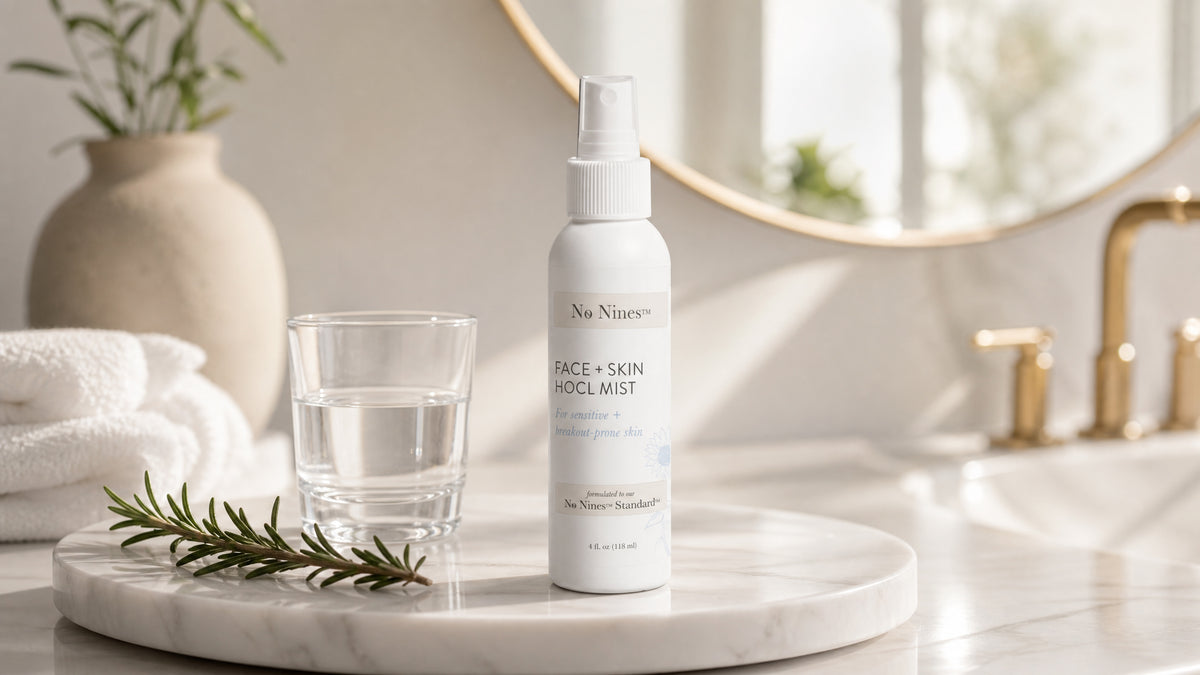
No Nines™ Standard™
Effective chemistry doesn't require unnecessary exposure.
Our ingredient decisions consider not only whether an ingredient can perform a function, but also how much is required, how people are exposed to it, what happens when it is misused, and whether a different chemistry can accomplish the intended purpose with a more favorable exposure profile.
Synthetic fragrance and parfum do not meet that standard for our formulations.
No synthetic fragrance.
No parfum.
No unnecessary exposure.
That is the No Nines™ Standard™.
Published Sources & Further Reading
1. U.S. Food and Drug Administration. Fragrances in Cosmetics. FDA explains the regulation of fragrance ingredients and the use of the collective “Fragrance” declaration for proprietary fragrance mixtures.
2. Giménez-Arnau A, Giménez-Arnau E, Serra-Baldrich E, Lepoittevin JP, Camarasa JG. “Principles and methodology for identification of fragrance allergens in consumer products.” Contact Dermatitis. 2002;47(6):345–352.
3. Reeder MJ. “Allergic Contact Dermatitis to Fragrances.” Dermatologic Clinics. 2020;38(3):371–377.
4. European Commission. Commission Regulation (EU) 2023/1545 of 26 July 2023 amending Regulation (EC) No 1223/2009 as regards labelling of fragrance allergens in cosmetic products.
5. Dittmar D, Schuttelaar MLA. “Contact sensitization to hydroperoxides of limonene and linalool: Results of consecutive patch testing and clinical relevance.” Contact Dermatitis. 2019.
6. U.S. Food and Drug Administration. Phthalates in Cosmetics. FDA discussion of phthalate use in cosmetics and fragrance, including diethyl phthalate (DEP), labeling considerations, and current safety assessment.
7. National Institute of Environmental Health Sciences. Endocrine Disruptors and research materials concerning personal-care-product chemical exposures.
8. Bitsch N, Dudas C, Körner W, et al. “Estrogenic activity of musk fragrances detected by the E-screen assay using human MCF-7 cells.” Archives of Environmental Contamination and Toxicology. 2002;43:257–264.
9. Katuri GP, Fan X, Kosarac I, Siddique S, Kubwabo C. “Synthetic Musk Compounds in Human Biological Matrices: Analytical Methods and Occurrence—A Review.” Journal of AOAC International. 2021;104(2):368–383.
10. National Institute of Environmental Health Sciences. “Some endocrine disruptors may contribute to early puberty, study finds.” Environmental Factor. 2024.
11. Kumar P, Caradonna-Graham VM, Gupta S, Cai X, Rao PN, Thompson J. “Inhalation challenge effects of perfume scent strips in patients with asthma.”
12. Vethanayagam D, Vliagoftis H, Mah D, et al. “Fragrance materials in asthma: a pilot study using a surrogate aerosol product.” Journal of Asthma. 2013.